
Decoding the Hydro-Mechanical Mechanism of a Shape Memory Microneedle Scaffold for Adaptive Vaginal Wound Repair. Advanced Functional Materials 2026, e29119.
Published in Advanced Functional Materials, 2026
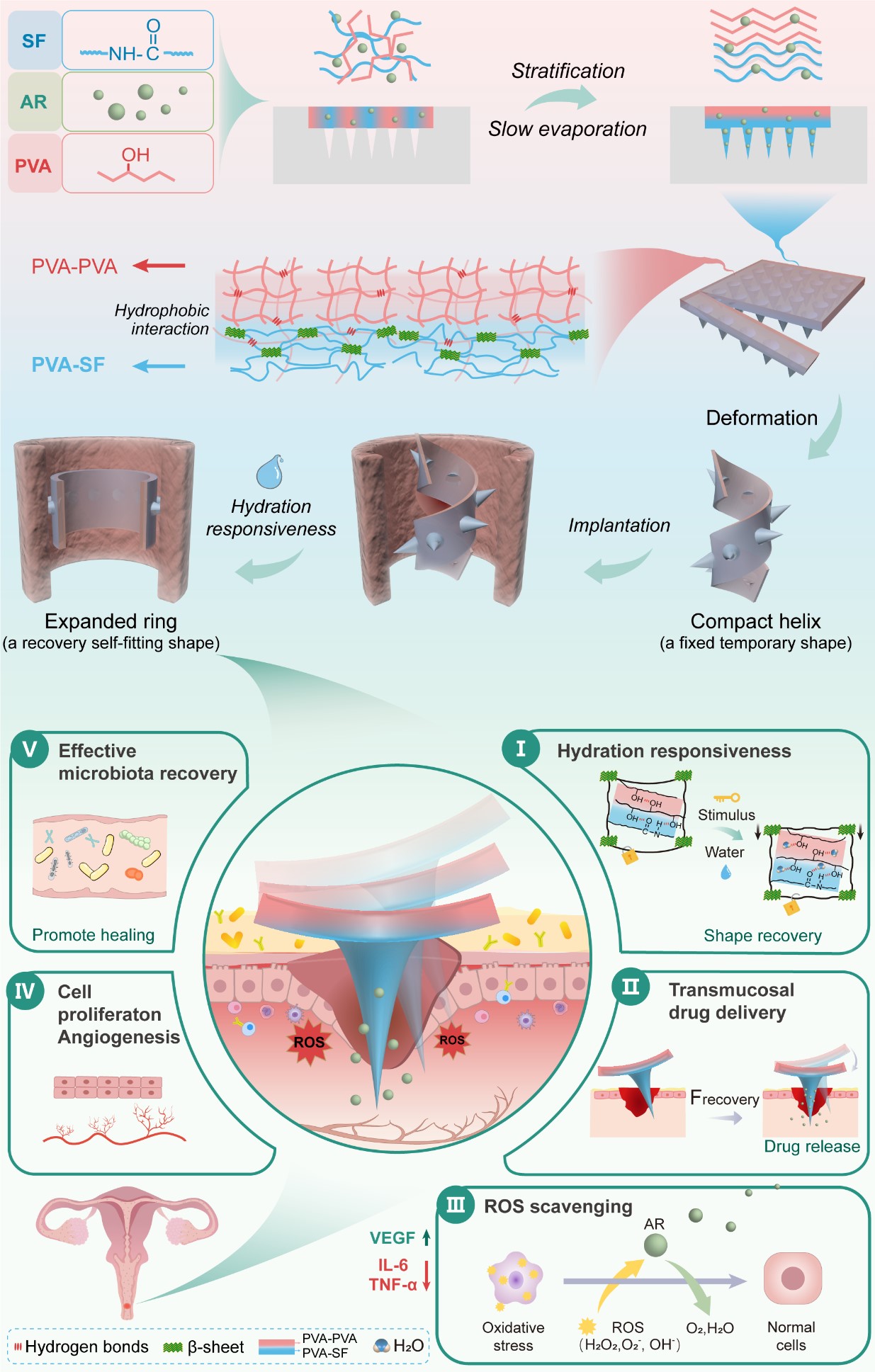
The management of Mayer-Rokitansky-Küster-Hauser (MRKH) syndrome is severely hampered by the inability of existing therapies to achieve conformal fitting and sustained drug release within the dynamic, moist vaginal environment. Herein, we report a novel Janus-structured microneedle (MN) system engineered from a poly(vinyl alcohol)/silk fibroin (PVA/SF) hybrid that overcomes these critical limitations through intelligent, hydration-triggered shape adaptation. A facile one-pot process induces spontaneous spatial segregation, forming an asymmetric bilayer architecture with a PVA-rich upper layer and an SF-enriched lower layer. This unique structure enables the device to be pre-programmed into a compact coil for minimally invasive insertion, which subsequently unfurls upon vaginal moisture exposure to achieve conformal contact with irregular wound surfaces. Crucially, we decipher the shape memory mechanism through 2D correlation spectroscopy and molecular dynamics simulations. These analyses reveal a sequential disruption of hydrogen bonds, while hydrophobic interactions from SF β-sheets provide exceptional mechanical stability in the hydrated state. In a rat model of severe vaginal injury, the arbutin-loaded MN (ARMN) scaffold orchestrates a holistic healing process—effectively scavenging ROS, suppressing IL-6-mediated inflammation, promoting VEGF-driven angiogenesis and PCNA-enhanced proliferation, and mitigating surgery-induced dysbiosis. This work establishes a pioneering paradigm of stimuli-responsive, self-adapting medical devices for transformative therapy in complex mucosal tissue regeneration.