
Polyphenol-functionalized silk fibroin incorporates self-assembled drug delivery platforms for oral ulcers treatment by robust wet adhesion and sustained drug release. International Journal of Biological Macromolecules 2025, 328, 147592.
Published in International Journal of Biological Macromolecules, 2025
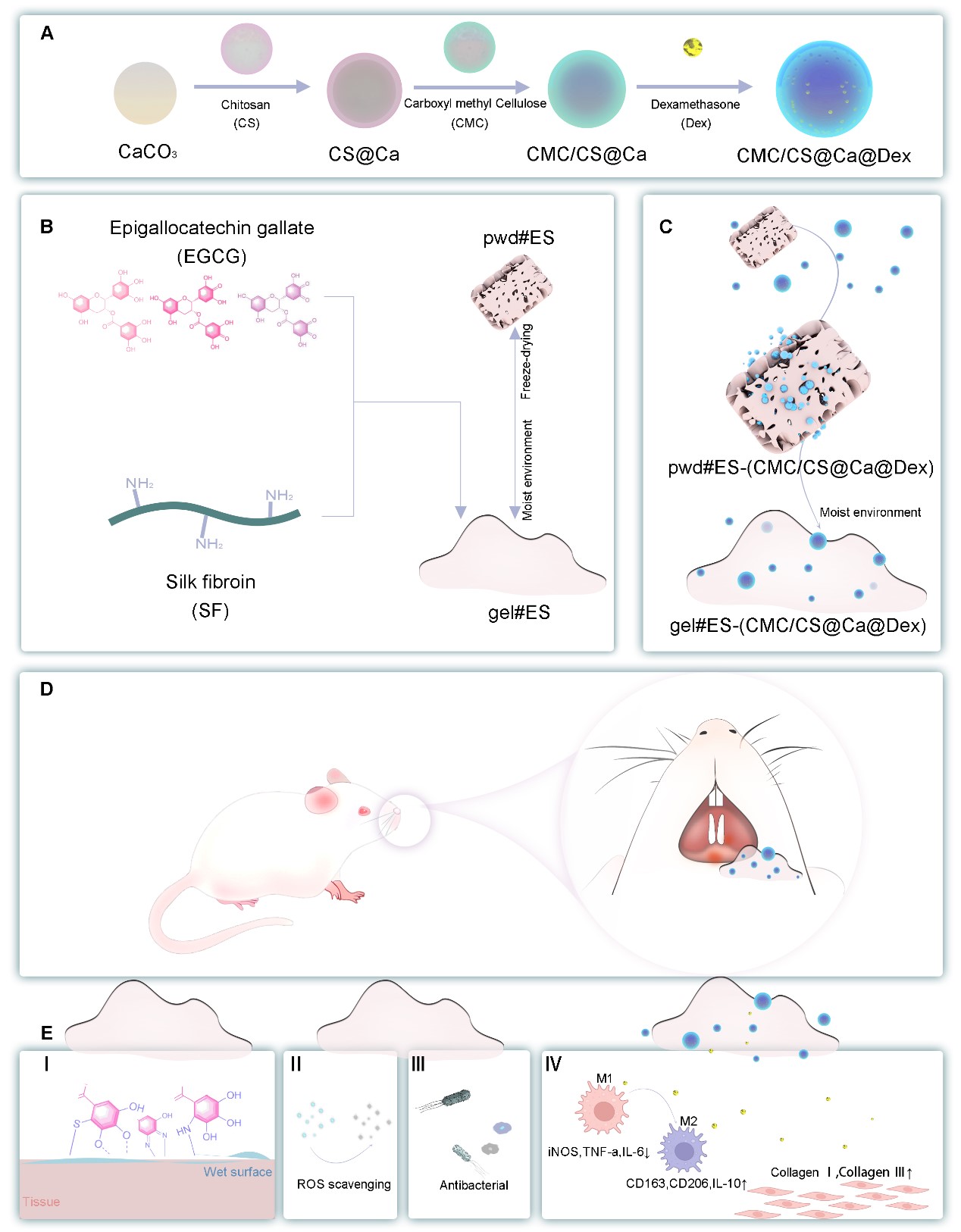
Oral ulcers (OU) represent a highly prevalent mucosal disease; however, treatment using existing dressings is often challenging due to insufficient wet adhesion and limited efficacy. In this study, a polyphenol-functionalized silk fibroin (SF) adhesive incorporating a drug delivery platform was developed for the treatment of OU. Silk fibroin (SF) was functionalized with epigallocatechin gallate (EGCG) to form dry granules (termed pwd#ES). Subsequently, drug delivery platforms loaded with dexamethasone (denoted CMC/CS@Ca@Dex) were doped into these granules, resulting in a composite dry granular SF dressing [pwd#ES-(CMC/CS@Ca@Dex)] designed for ulcerated mucosal tissue. The CMC/CS@Ca@Dex platform was prepared by self-assembling chitosan (CS) and carboxymethyl cellulose (CMC) layer-by-layer onto CaCO₃ cores, followed by dexamethasone loading. The resultant composite SF dressing exhibited strong wet tissue adhesion (32.8 kPa), mediated by synergistic interactions within the polyphenol-functionalized SF matrix, alongside excellent reactive oxygen species (ROS) scavenging and bactericidal activity attributed to EGCG. In a mouse model of OU, the pwd#ES-(CMC/CS@Ca@Dex) dressing significantly accelerated healing and promoted faster re-epithelialization. This pwd#ES-(CMC/CS@Ca@Dex) dressing is anticipated to improve the efficiency of OU treatment and inspire the rational design of wet tissue adhesives for the repair of moist tissue defects.